Project CHALLENGE
The brief was simple and straightforward; to design a charge sheet automator.
One might ask, what exactly is a charge sheet? It is a simple yet formal police record that contains the exact crime details. Some examples are the names of each person brought into custody and the nature of accusations. However, we heard that there are variations to a charge sheet. While the most basic one contains information of a single crime conducted by an individual, others might contain an amalgamation of charges to a person, or a crime conducted by a group of individuals.
Currently, the charge sheet is win Microsoft Word before submitting to the court through a system. Unless it is a complicated crime, the charge sheet is usually done by an officer by the end of the shift cycle. It takes time and effort to draft while juggling with other roles, hence this project was suggested.
The police force wanted to speed up the process by introducing a digital form to automate the process with relevant information from their existing systems. In addition, they were open to suggestions that can streamline their work process.
Solutions and impacts
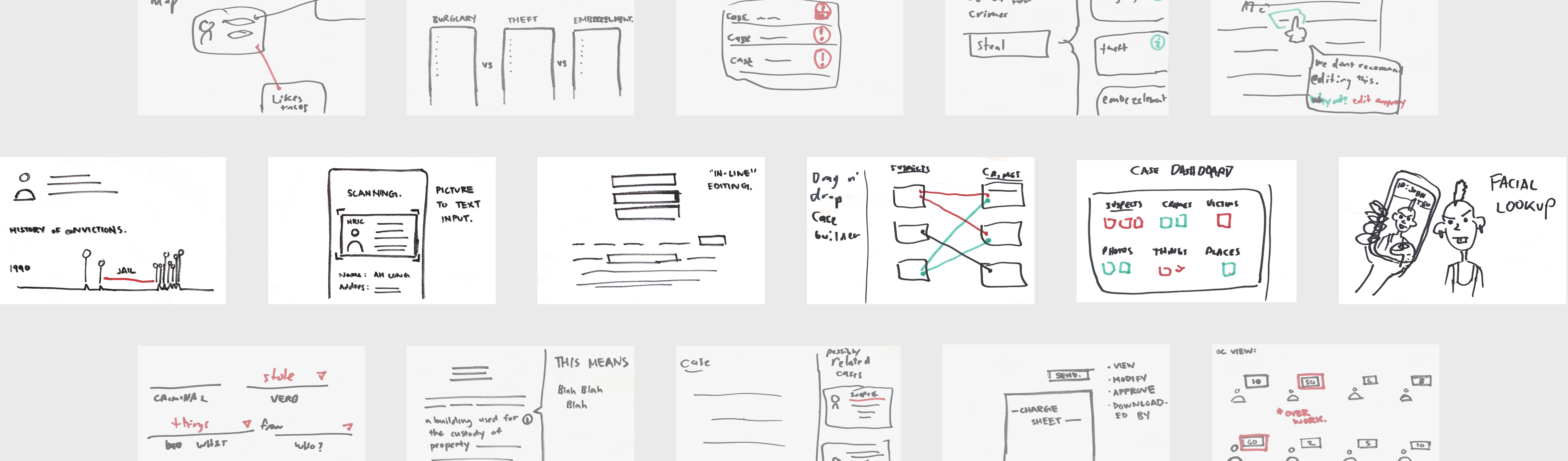
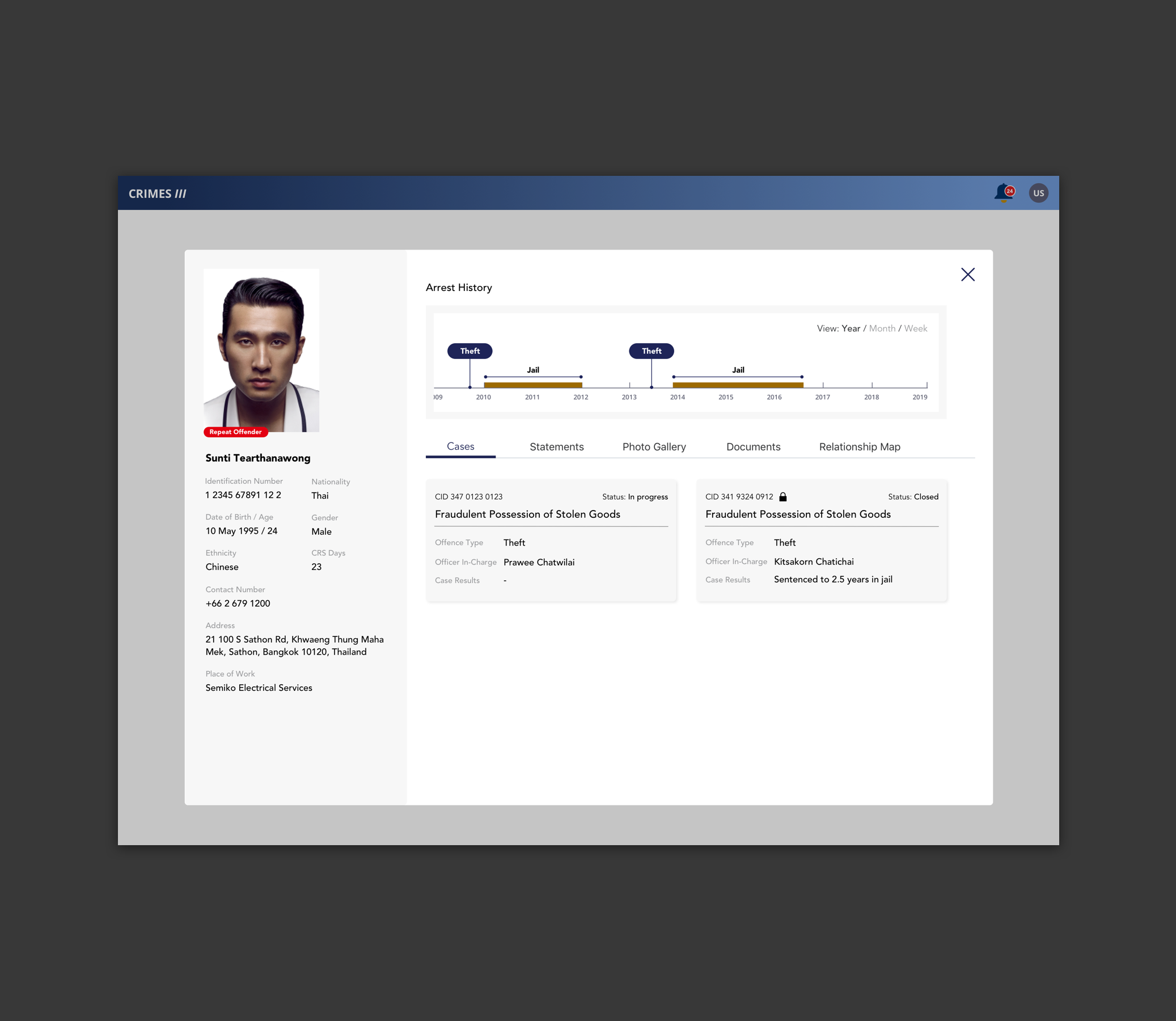
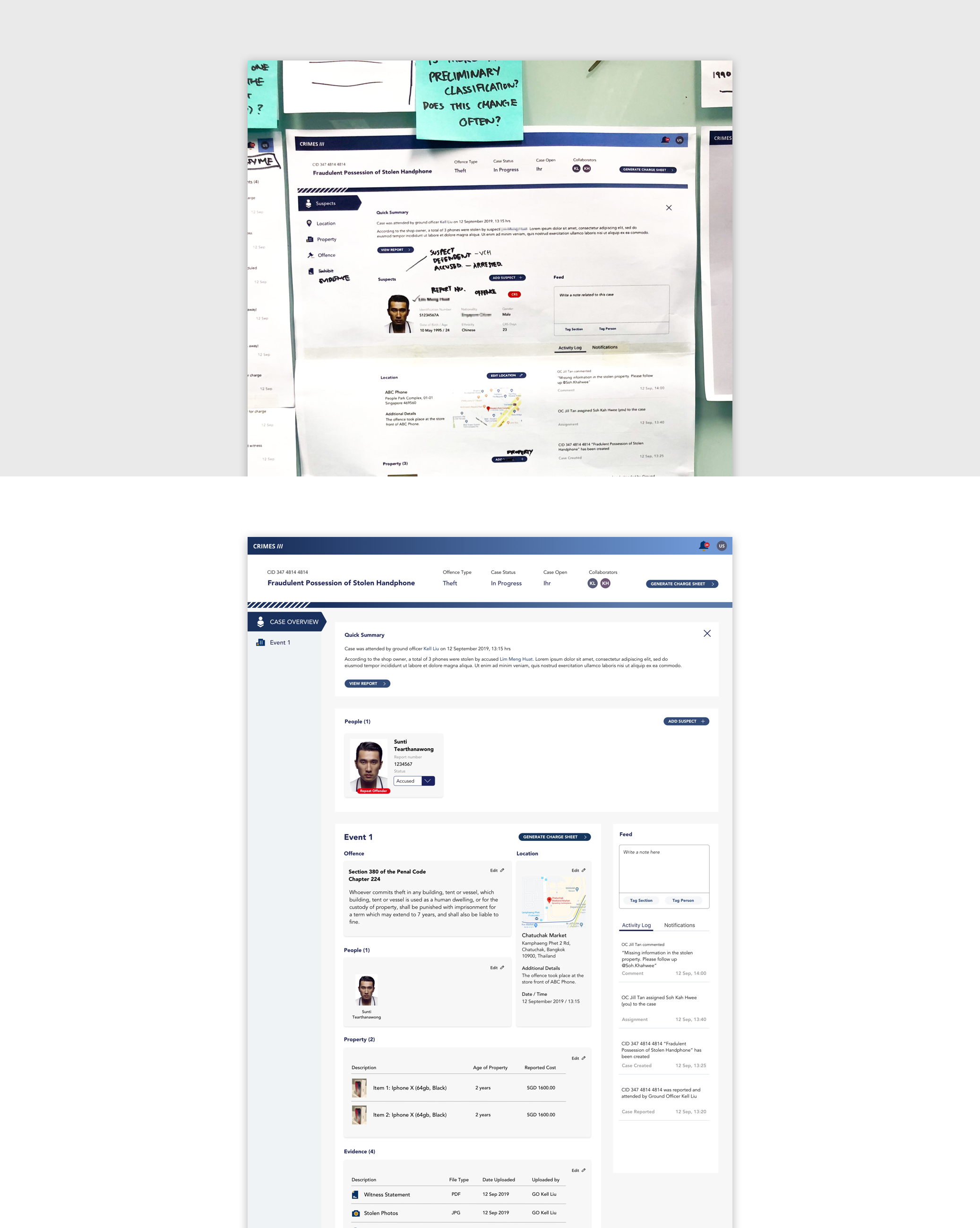
The outcome of this project is an integrated, centralised program where users can work individually or as a team to create new cases. One can leverage the existing historical data to write and create clear connection between cases. On top of that, the program also manage their workload through a tracking and reviewing system to prevent burn out.
Discovery
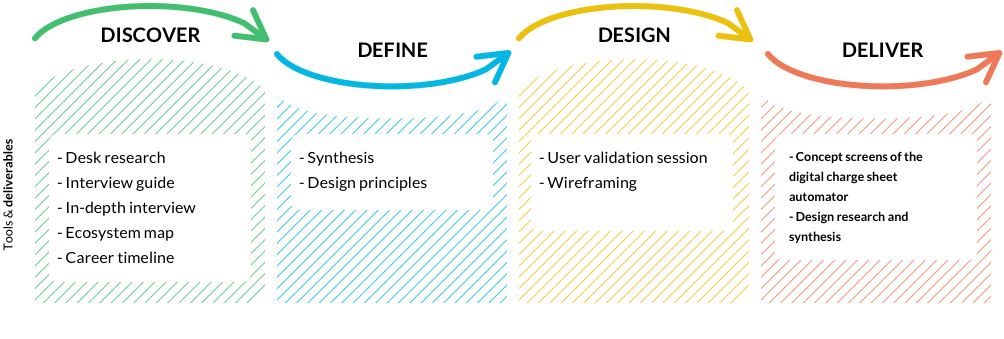
Together with the team, we conducted 5 initial interviews with junior and senior officers from various departments. All of them had ground work experiences before moving to their current desk-bound roles.
When it comes to the law, many officers are careful with what they disclose through the interview. In order to make the session more interactive and less formal, I incorporated two simple activities to aid the participants in visualising a crime journey. This starts from when a crime was reported, until the case has been assessed and closed.
The main objective of the interviews was to understand why a charge sheet automator was needed to reduce the working time. While doing so, policemen explained the journey of a crime investigation process through a timeline and an ecosystem map to understand the current working relationship with other departments as well as the tools they use.
Asking for a demonstration on their existing system also revealed an avalanche of insights.
Defining — insights
1. Manual inputs allow too much room for mistakes
2. Heavy workload encourages simpler charge sheet
3. Mistakes are the worst nightmares
4. A policeman's mindsets
5. Competitive culture within the company
6. Inconsistent charge sheet format and writing style
1. Manual inputs allow too much room for mistakes
When a police report is made, ground officers arrive at the scene to evaluate and record any evidence and statements from witnesses. These notes are handwritten in a notebook and photographs of evidence are captured in a duty phone. He then returns back to his office to download all the evidences and make connection with all the data points. The transfer of information from a notebook into the computer is the first phase where information can be lost through human errors.
2. Heavy workload encourages simpler charge sheet
While writing a case, policemen should proactively look for historical cases to draw possible links. However, due to high workload, most of them would rather complete the charge sheet quickly so that they can work on other tasks than to look from other sources. Instead of logging the charge sheet with as many data points as possible, one would prefer to forgo that to meet his other KPIs.
The existing Microsoft Word template encourages the officer to work in silo with his handwritten data as the only source of truth.
3. Mistakes are the worst nightmare
When it comes to editing an error in the charge sheet, the officer has to correct it offline before resubmission. This means that the effort taken to amend the mistake is doubled for every charge sheet that is linked to the initial source.
4. A policeman’s mindsets
Previously, it was mentioned that the variation of a charge sheet depends on the complexity of a case. This is highly related to the mindsets of a policeman as he approaches a case. We figured that there are two mindsets — event-centric and user-centric. The first mindset is commonly used when there are multiple venues or perpetrators while the latter is taken usually when there is a single crime. These mindsets decide how a case is logged by an officer on the existing system.
5. Competitive culture
Every year, departments are reviewed against one another with the same key performance indicators. This creates a very competitive culture that discourages communication and sharing of information between teams. When one needs to collect information from another team to fill in the charge sheet, the newer policemen often find it challenging to gather data efficiently. This results in an incomplete report that might need more attention down the road.
6. Inconsistent charge sheet format and writing style
An outdated knowledge exchange library with the best in class examples has caused new police officers to rely heavily on their predecessors’ charge sheets. Moreover, the absence of a fixed template across the police force has encourage many different versions to be created. Simplified legal terms or sentences from the original example is commonly seen in today’s charge sheet.